Switching to PPS+: What Changes in the First Twenty-Four Hours
At 1,811 TH/s a day of mining is worth 0.00081247 BTC, or $68.81 at $84,692, and $66.06 once the listed 4% on the block-reward component is removed. Move an account from PPLNS to PPS+ and that income starts arriving in hourly steps instead of waiting for six confirmations. The first day is mostly about learning what normal now looks like.

Key takeaways
- 1,811 TH/s produces 0.00081247 BTC a day, or $66.06 net after the listed 4%.
- PPS+ credits hourly against current difficulty, so the first payment lands within the hour.
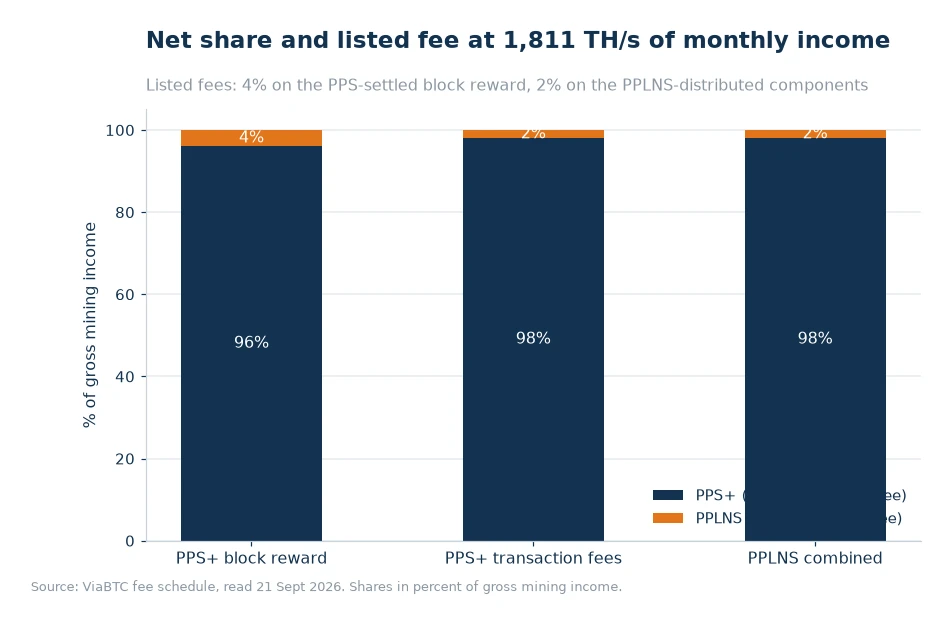
- Only the block-reward component pays 4%; the transaction-fee slice follows the 2% line.
- Judge the switch on a week of credits, not on the first few hours.
What the switch actually changes
Three things change at once and only one of them is the rate. Settlement frequency moves from block-driven to hourly. The base splits into a subsidy component at a listed 4% and a transaction-fee component at a listed 2%. And the wait for the first credit shrinks from days to minutes, which is the part most operators notice first.
What does not change is the hashrate, the worker configuration or the coins per unit of work. The machines keep submitting shares at the same rate; the accounting behind them changes shape. That is why a switch can feel dramatic on the wallet page and uneventful on the miner dashboard, and why the first day is a poor sample for judging the economics.
The first six hours
If the switch happens at the top of an hour, the first credit should appear within that hour, sized against current difficulty rather than against any earlier period. Do not expect a catch-up payment for shares submitted before the change; the scheme applies from the moment it is set, and the old scheme's tail settles under its own rules.
By hour six the account should show six credits. Their sum is a sixth of the daily rate, less the usual hour-to-hour variation in difficulty and share luck. At 1,811 TH/s the gross for six hours is about $17.20, and the net about $16.51 after the listed 4% on the subsidy side. A figure in that neighbourhood is normal; a figure half that size is worth a query.
Two checks make the first six hours useful. Confirm that every worker string appears exactly once, and confirm that the number of credits equals the number of hours since the change. A missing worker is a configuration issue that costs a full day's income if it waits until morning; a missing credit with all workers present is a settlement question for support, and either way the timestamp of the first expected payment is the detail that speeds up the answer.
Two lines, two rates
The statement will not show a single deduction. It shows the block-reward component paying the listed 4% and the transaction-fee component paying the listed 2%. In a quiet mempool the fee slice is small, so the blended cost sits close to 4%. In a busy week the fee slice grows and the cheaper rate applies to more of the total.
This is the detail that makes cross-pool comparison difficult, and it is worth reading the ViaBTC Pool Fees page before the switch rather than after. An operator who expects one blended six-percent line will see a smaller deduction and wonder what went wrong. An operator who expects 4% on everything will see a slightly larger one in a busy week and wonder the same thing in reverse.
The practical response is to note the split once and then ignore it. What matters on a normal day is the net number, and the net number is the gross minus the two component charges. Put the split in your notes for the month-end review, where a busy week's effect on the fee slice is visible; do not re-derive it every morning.
What will not appear on day one
Two things lag. The first is the transaction-fee slice, which follows PPLNS logic and therefore depends on a window of recent difficulty rounds rather than on the current hour. The second is any residual from the previous scheme, which settles on its own schedule after six confirmations. Neither is missing money; both are timing.
The wallet balance is the place to watch, not the estimated earnings figure. A displayed estimate is a projection at current difficulty, while the balance is what has actually been credited, and the Profit Calculator is the cleaner way to produce that projection. On the first day the two can differ by a few percent simply because difficulty moved inside the day, and that gap is not evidence of a problem.
Keep a twenty-four hour log
Record the balance at the same minute every few hours and note the difficulty at the start and end of the day. The log turns a vague impression into a series, and the series is what you will compare against next week. It also catches the one real failure mode: a worker that stops submitting after the switch and produces no credits at all.
Add one line for the hashrate reported by the pool and one for the host or miner dashboard. If the two agree and the credits accumulate at the expected rate, the switch is complete. If the credits are flat while hashrate is fine, the issue is on the payout side and belongs in a support ticket with timestamps attached.
The log is also the only fair way to compare the old scheme with the new one. A remembered PPLNS total from last month was produced at a different difficulty and a different fee load, so holding it against today's hourly credits is not a comparison. Keep both series, note the difficulty beside each, and the difference between them becomes arithmetic instead of recollection.
| Hours elapsed | Gross BTC | Gross USD | Listed 4% | Net USD |
|---|---|---|---|---|
| 6 | 0.00020312 | $17.20 | $0.69 | $16.51 |
| 12 | 0.00040624 | $34.41 | $1.38 | $33.03 |
| 18 | 0.00060935 | $51.61 | $2.06 | $49.55 |
| 24 | 0.00081247 | $68.81 | $2.75 | $66.06 |
Worked example
Build the day from the network down, then cut it into hours.
- The network creates 450 BTC every day, from 144 blocks of 3.125 BTC.
- One terahash's share is 450 ÷ 1,003,000,000 = 0.00000044865 BTC.
- 1,811 TH/s × 0.00000044865 = 0.00081247 BTC a day.
- At $84,692: 0.00081247 × 84,692 = $68.81.
- Hourly gross: 68.81 ÷ 24 = $2.87, or 0.00003385 BTC.
- Listed 4% on the block-reward base: 68.81 × 0.04 = $2.75 a day.
- Net: 68.81 − 2.75 = $66.06 a day, and 66.06 ÷ 24 = $2.75 net an hour.
- After six hours: 6 × 2.75 = $16.51 net, matching the table's first row.
Frequently asked questions
When does the first PPS+ credit arrive?
Within the first hour after the setting changes, because PPS+ settles hourly against current difficulty. Credits for shares submitted before the change belong to the previous scheme and settle under its rules.
Why is the deduction smaller than 6%?
Because the listed 4% applies only to the block-reward component and the listed 2% only to transaction fees. When fees are a small share of gross income, the blended deduction sits much closer to 4% than to 6%.
Should I switch back if the first day looks low?
Not on one day. Difficulty and share luck move the daily figure by a few percent either way, so compare a full week of credits before drawing a conclusion about the scheme.
Let the week decide
Give the new scheme seven days, keep the log running, and compare the total with the same week's difficulty rather than with a remembered number from the old scheme. The multi-currency wallet shows each credit as it lands, which makes the tally a matter of reading rather than reconstructing.
If the credits match the arithmetic, the switch is done and the only remaining task is to decide whether hourly settlement suits the way the operation pays its bills. That is a cash-flow question, and it deserves its own review once the first full week is on record.
Sources: ViaBTC fee schedule and wallet pages, read 21 Sept 2026[1]. Assumptions: network hashrate 1,003 EH/s, difficulty 132.76 T, 144 blocks daily paying 3.125 BTC, BTC $84,692. Published 24 Oct 2026; figures assume continuous uptime.